Saturday, March 1, 2008

Jura Neikena Dikli Elementary school’s Comenius project’s group in Vidzemes University college.

On Monday, February 25th, Comenius group of the Jura Neikena Dikli Elementary school visited Vidzemes University college and listened Vidzemes University college’s associate professor Juri Smalinski presenting Eco tourism in a very interesting way.
He informed us about Eco tourism in Dikli, in Latvia and all over the world, as Asia, Africa, America, Australia and Oceania.

He started with definition of ecotourism. We discussed how people in Latvia and everywhere in the world comprehend ecotourism . Ecotourism – it is green thinking and using natural products - an idea born in Costa Rica.
Ecotourism is responsible traveling along a nature locality .Ecotourism doesn’t leave negative influence to nature and improve native people welfare, stimulate environment’s protection.
Our pupils took very active part in discussion, special Aksel and Aigar. It was important for me.
We discussed about Ecotourism Union of Latvia., which is founded in July 2000 and what is its tasks. Then we discussed about ecotourism in Dikli and surroundings of Dikli.
The professor told us about ecotourism experience in Brazilia, too.

At the end of presentation professor put accent to ecotourism as long life tourism Ecotourism has a negative aspects , too. It endangers local people interests, culture . It degrades environment and social life of local people.
This presentation was very important for our project’s group and we are very grateful to professor Juri Smalinski.
After presentation we visited Valmieras museum. We watched and improved Mathematics’ games.

Friday, February 22, 2008

Interview with Christoph Sigmund

Friday afternoon Mr. Christoph Sigmund, the general manager of the Arena Nova, was available for an interview. A four students group, headed by Evelyn Seidler, met him in his office. Sophie Gruber cared for the documentation and was responsible for pictures, Viktoria Wersonig videoed the complete interview using two cameras, Georg Piribauer was responsible for the notes and Evelyn asked Mr. Sigmund about his job, qualification, tourism aspects of an important event center and – last but not least – about future jobs for young people.

Mr. Sigmund answered patiently the questions, he presented a very open-minded approach to our project and we got all the information we were interested in.

The following private discussion with Mr. Sigmund demonstrated an interesting life of a great personality. Thank you, Mr. Sigmund, for the chance to talk with you and for your precious time you spent us!


Video: Evelyn Seidler talking with Mr. Sigmund about education and qualification for jobs.

Tuesday, February 19, 2008

Interview with director Koppensteiner

Sarah, Masi and Krisi made an appointment to talk with Mr. Norbert Koppensteiner about the museum and the aspects of tourism in connection with the museum.

They were welcomed cordially and Mr. Koppensteiner spent the complete Monday afternoon to give the requested information and to show them round in the current exhibition.

As there was an exact plan developed by the three students everyone had its own job: Sarah run the interview, asking the (well prepared questions), Marsi cared about the written documentation and Krisi videoed the meeting.

After a short coffee break Mr. Koppensteiner guided the interview team through the exhibition to show the highlights of the museum. An exciting moment was to sit in the rear seats of the original Daimler – a car produced in Wiener Neustadt and about 100 years old – the students felt like princesses …

The result of this meeting (written documentation, about 100 digital pictures, video scenes and a complete cut of the interview as an mp3-file) is shared by the group and enhanced to a case study about the museum as a point of tourist’s interest.

The interview team: Masi, Sarah and Krisi

Thursday, February 14, 2008

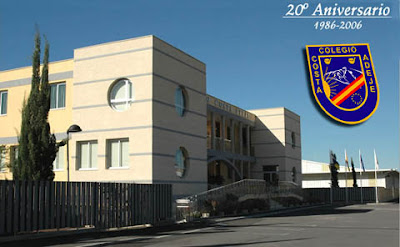
Colegio Costa Adeje - my stay in Tenerife

I’ll publish my impressions of my stay in Tenerife. I had the possibility to stay at school for some days and I will publish some pictures of the restructuring and comments about what I’ve seen there.


The new connection between the new building and the lower classes of primary school and ESO crosses the courtyard and leads directly from the stairways of the new building to the classrooms of the first building.


The stairwas in the new building are a modern construction with free areas between the two parts of the main building - coverd and protected by a modern and pleasant glass roof - curved and protective ...


The work with students of different ages (starting from the 3°eso to the 4°eso and the 1st bachilerato was both a challenge and exciting for me.

I obtained a lot of new experiances and was welcomed in a very heartly way.


Some instructions about e-learning were a contribution to advanced training for teachers.

It was great to work at this school!


Wednesday, February 13, 2008

Nature & Tenerife

Nature in Tenerife is completely different from the well known environment of an Austrian citizen. The huge number of endemic plants, the volcanism of the Island and the mammals living in the deep blue sea between Tenerife and Gomera are really impressing. I was on the way to find bottlenose dolphins and pilot whales with a small catamaran and had a good guide – less than an hour and we could watch some dolphins and – in distance – we could recognize some whales breathing at the surface of the sea.

Very impressing was the way into the barranco de inferno – strange flowers and some “perdiz” were found along the way deep into the canyon. The partridge (= perdiz) is not the same we know from our meadows and veldt round Wiener Neustadt (there we have the brown “perdix perdix") – it’s colored and looks very beautiful …


Monday, February 4, 2008

EDUCATION SYSTEM IN LATVIA

Education in Latvia is composed of three levels; nine years compulsory, secondary and higher education. Vocational schools, art schools, business schools, schools for special types of children, and kindergartens also form part of the programme.
There are private schools and universities, where fees are charged. But majority of students go to state schools which are free.
The main purpose of the nine year school is the general intellectual and social development of the child from 7 to 15 years of age. Promotion from one grade to the next is based on the pupils” skills in all school subjects and on the results of tests.
In secondary schools most pupils follow a course that includes Latvian, science, social studies, mathematics, physical education, foreign languages. Elective subjects may be chosen according to the student’s interests. A student is graded from 10 (outstanding) to 1 (failing) in each subject he takes. Students receive report cards twice a year.
At the end of the 12th grade every school-leaver is supposed to take 2 compulsory exams chosen by the Minister of Education and 3 exams in the subjects each individual student has selected himself.
About 80% of young people graduate from school with a General certificate of education. To get this certificate each student must complete a specified number of subjects and pass 6 final exams graded no less than 4 and upwards. Usually pupils have a separate teacher for each subject.
Schools in Latvia begin on September 1 and end at the end of May. The year is divided into semesters, typically – September- December – January – May. The school breaks for holidays 4 times a year. There is a week holiday at the end of October, 2 weeks at Christmas Holidays, a week at Easter.
Every pupil goes to school at least 7480 hours from grade 1 to 9. Many pupils spend more time at school. So school takes up a lot of time and therefore it must be a good place to be. Even the best of schools can be made better and students can take part in this. If students are unhappy with something, they often just grumble about their teachers, parents or the administration and do no more about it. This very rarely does any good, but there is another option. You must take an active part in the pupils” council.
  • Is there any at your school?
  • What is it like to be a pupil at your school?
  • How would you like it to be?
  • What specific things can you do to improve the school for pupils?
  • It is important to be active, and remember:
    „Nothing ventured, nothing gained”.

Friday, December 28, 2007

Colegio Costa Adeje - Presentation

Colegio Costa Adeje

The “Colegio Costa Adeje” was founded in 1986 in the Southwest of Tenerife. It is a private, laic and mixed school which strives for excellence in education from Nursery school to the last year before going to university.


The philosophy of our school has always been to bring up students with a fully responsible attitude, freedom and, overall, concern about social problems with a clear idea in progress based on freedom, fairness and tolerance;
summed up in the following basic outline:

  • Quality in teaching.

  • Quality in education.

  • Understanding and respect for values.

  • Students and parents Counselling Service.

  • New technologies.

In our school, there are students of more than 20 nationalities; therefore, one of our main aims is the teaching of foreign languages. That is why students of all levels have to attend lessons of German and English, and they are well prepared to participate in external exams, such as, those of the Goethe Institute and those of the Official School of Languages. Moreover, once a year some of our students have the possibility of travelling abroad to Germany or England with the aim of improving and achieving a high level at foreign languages.

Our team at the “Colegio Costa Adeje” is composed by the following teachers:


  • María Dolores Mateos Peña: English teacher, responsible for English language and translation.

  • María Dolores Marrero González: Teaches Mathematics and Informatics.

  • Sergio Pastor: Teaches Biology, speaks English and French.

  • Jorge G. González: English teacher, responsible for English language and translation.

  • Nuria Marrero: Teaches Physics, Chemistry and Technology, speaks German and English.

We are going to work at the project with 30 students, who are 15 years old and attend to the third level of the Compulsory Secondary Education class.

Description of the pictures:
Top: The front of the school with the new built entrance
Small pictures:
- library
- meeting hall
- courtyard of the primary school
- kindergarden